 Skip-the-line available
 The Manueline Window at Tomar — Iberia's Most Famous Carved Window
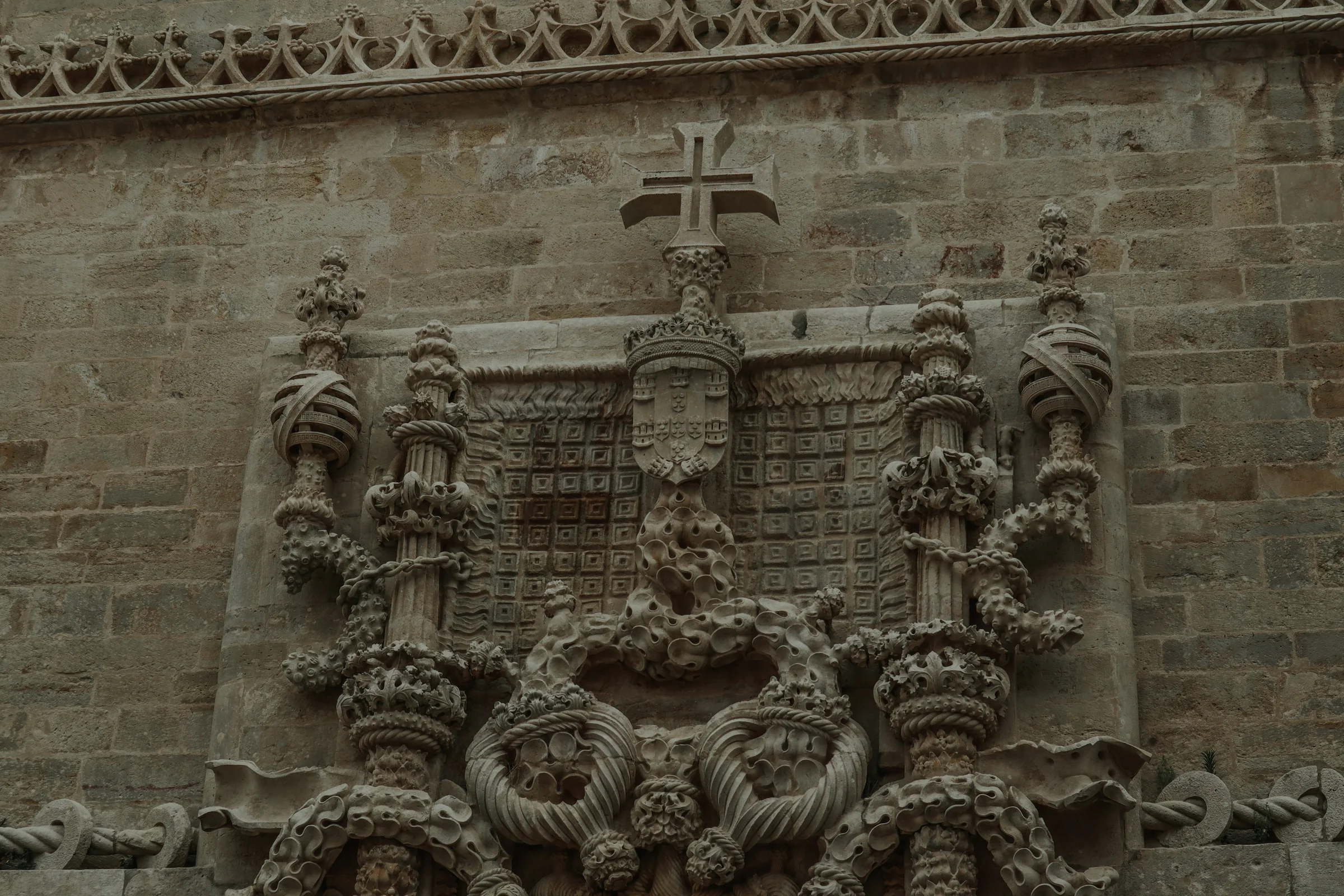
The Janela do Capítulo on the west facade — every symbol of Portugal's Age of Discovery carved into a single 16th-century stone window.
The Manueline Window at the Convent of Christ — formally the Janela do Capítulo (Chapter House Window) — is the most famous single carved window in Portugal and one of the most photographed details of Iberian late-Gothic stonework. It sits on the west facade of the Chapter House, carved by Diogo de Arruda between 1510 and 1513 during the reign of Manuel I, with every recurring motif of Portuguese Age of Discovery symbolism compressed into a single composition.
Where to find the window
The window is on the west facade of the convent's Chapter House — outside the main church, accessible from the exterior of the monastery complex. From the visitor entrance, walk around the building to the west side; the window faces a small courtyard. Most visitors miss it the first time because it's not on the main interior tour route. Look for the signposted 'Janela do Capítulo' marker.
The exterior position means the window is best viewed at standing height from below. Photographers with longer lenses can capture the carved detail; mobile cameras work well with 2x zoom. The west-facing position means late-afternoon light is optimal — 90 minutes before sunset gives the strongest shadow definition on the carved motifs.
The motifs — what's carved
The window's frame is densely carved with overlapping motifs. The recurring Manueline symbols all appear: ropes (cabos) twisted around the frame, anchors (âncoras), the armillary sphere (the personal emblem of Manuel I — an open-frame globe model with rings), the Cross of the Order of Christ, oak leaves and acorns (Manuel I's royal symbol), corals, seaweed, and small ships.
Distinctive to this window: a carved figure at the base of the frame holding the rope (interpreted by some scholars as a sea-veteran sailor, by others as a personification of Portugal itself), and a band of carved heraldic shields above the window. The carving is by Diogo de Arruda, working under his brother Francisco de Arruda; the work is dated 1510-1513 and is contemporary with the early phase of the Jerónimos Monastery in Belém.
What the window symbolises
Art-history interpretation reads the window as a compressed visual celebration of Portugal's Age of Discovery — the seafaring exploration along the African coast that Henry the Navigator had launched a century earlier and that was reaching its peak during Manuel I's reign. The maritime motifs (ropes, anchors, armillary spheres, ships) tie directly to the discovery narrative; the religious motifs (the Cross of the Order of Christ) tie to the religious authority granted to Portuguese exploration by Papal bulls.
The window is also a political statement. The Order of Christ was Portugal's wealthiest religious institution, with most of the wealth coming from the Templar inheritance plus the rights granted by the crown to revenues from the Age of Discovery. The lavishly decorated window on the Chapter House — where the Order's senior knights met — is essentially a propaganda piece, asserting the Order's continuing centrality to Portuguese identity and power.
Best time to see and photograph
Late afternoon (90 minutes before sunset) is optimal — west-facing window catches warm low light, casting strong shadows that define the carved motifs. Morning shadows obscure the detail; midday flattens it. In summer, the optimal window is 18:30-20:00; in winter, 15:30-17:00.
Photo tips: full-frame composition with the entire window visible, or close-ups of the lower frame where the carved figure and the most-detailed maritime motifs are. The corner where the rope meets the armillary sphere is the most-photographed single detail. The window is hard to photograph well from directly below — step back 5-10 metres for the best angle.
Frequently asked
Where is the famous Manueline Window at Tomar?
On the west facade of the Chapter House at the Convent of Christ — outside the main church, accessible from the exterior of the monastery. Most visitors miss it without signposting; look for 'Janela do Capítulo' markers in the convent.
Who carved the Manueline Window?
Diogo de Arruda, working under his brother Francisco de Arruda, between 1510 and 1513 during the reign of King Manuel I. The brothers are among the most important sculptors of the Portuguese Manueline period; they also worked on the Belém Tower in Lisbon.
What do all the carved symbols mean?
The carved motifs are compressed symbols of Portugal's Age of Discovery: ropes (cabos), anchors (âncoras), the armillary sphere (Manuel I's emblem), the Cross of the Order of Christ, oak leaves (Manuel I's royal symbol), corals, seaweed, and small ships. The figure at the base of the frame is interpreted as a sea-veteran sailor or as a personification of Portugal.
How big is the window?
Substantial — about 3 metres wide and 4 metres tall in the carved-frame portion, with the carved decoration extending another metre on either side. The window itself opens into the Chapter House interior. Carved-stone area is approximately 18-20 square metres.
What is the best time to photograph the Manueline window?
Late afternoon, about 90 minutes before sunset — west-facing position catches warm low light. Summer 18:30-20:00, winter 15:30-17:00. Avoid midday flat-light and morning shadow.
Is the Manueline Window similar to anything in Belém?
Yes — the Janela do Capítulo at Tomar and the Manueline ornament at the Jerónimos Monastery in Belém are contemporary works by similar sculptors. Both Belém and Tomar represent the peak of Portuguese Manueline carving in the early 16th century, celebrating the Age of Discovery.