 Skip-the-line available
 The Convent of Christ — From Templars to Order of Christ
How a 1160 Templar fortress became the headquarters of Portuguese maritime exploration, through 850 years of building campaigns.
The Convent of Christ has one of the most layered histories of any Portuguese monastery. Founded in 1160 by the Knights Templar, transferred to the Order of Christ after the Templars' 1312 dissolution, used as the headquarters of Portuguese maritime exploration under Henry the Navigator, and added to across eight centuries of construction. This guide is the clear factual timeline.
The Templars — 1160 to 1314
The Knights Templar were a 12th-century military-religious order, founded in Jerusalem in 1119, that played a major role in the Iberian Reconquista. King Afonso Henriques granted them land at Tomar in 1159; their Grand Master in Portugal, Gualdim Pais, founded the convent and the Templar fortress in 1160. The Charola (the round church based on the Holy Sepulchre in Jerusalem) was completed around 1190 and remains one of the very few medieval round churches in Europe.
The Templars at Tomar became one of the wealthiest and most politically powerful institutions in Portugal. Their fortress and the surrounding lands controlled the central frontier with the Moors during the 12th and 13th centuries. The Order's headquarters in Portugal was at Tomar; the Templar church and adjacent fortress were continuously expanded through the late 12th and early 13th centuries.
The Order of Christ — 1319 onward
In 1312, Pope Clement V dissolved the Templar Order across Europe under pressure from King Philip IV of France. In most kingdoms the Templars' property was transferred to other religious-military orders or seized by the crown. In Portugal, King Dinis successfully argued for the creation of a new Portuguese order to inherit the Templar property — the Order of Christ, founded in 1319. The Convent of Christ became the new order's headquarters.
Under the Order of Christ, the convent continued to expand. Most significantly, Henry the Navigator (Infante Dom Henrique, 1394-1460) became Grand Master of the Order in 1420 and used the wealth of the Order — much of it inherited from the Templars — to finance Portuguese maritime exploration along the African coast. The Order of Christ symbol (a red cross with a smaller white cross inside) decorated the sails of Portuguese caravels during the Age of Discovery.
The Manueline phase — 1495 to 1521
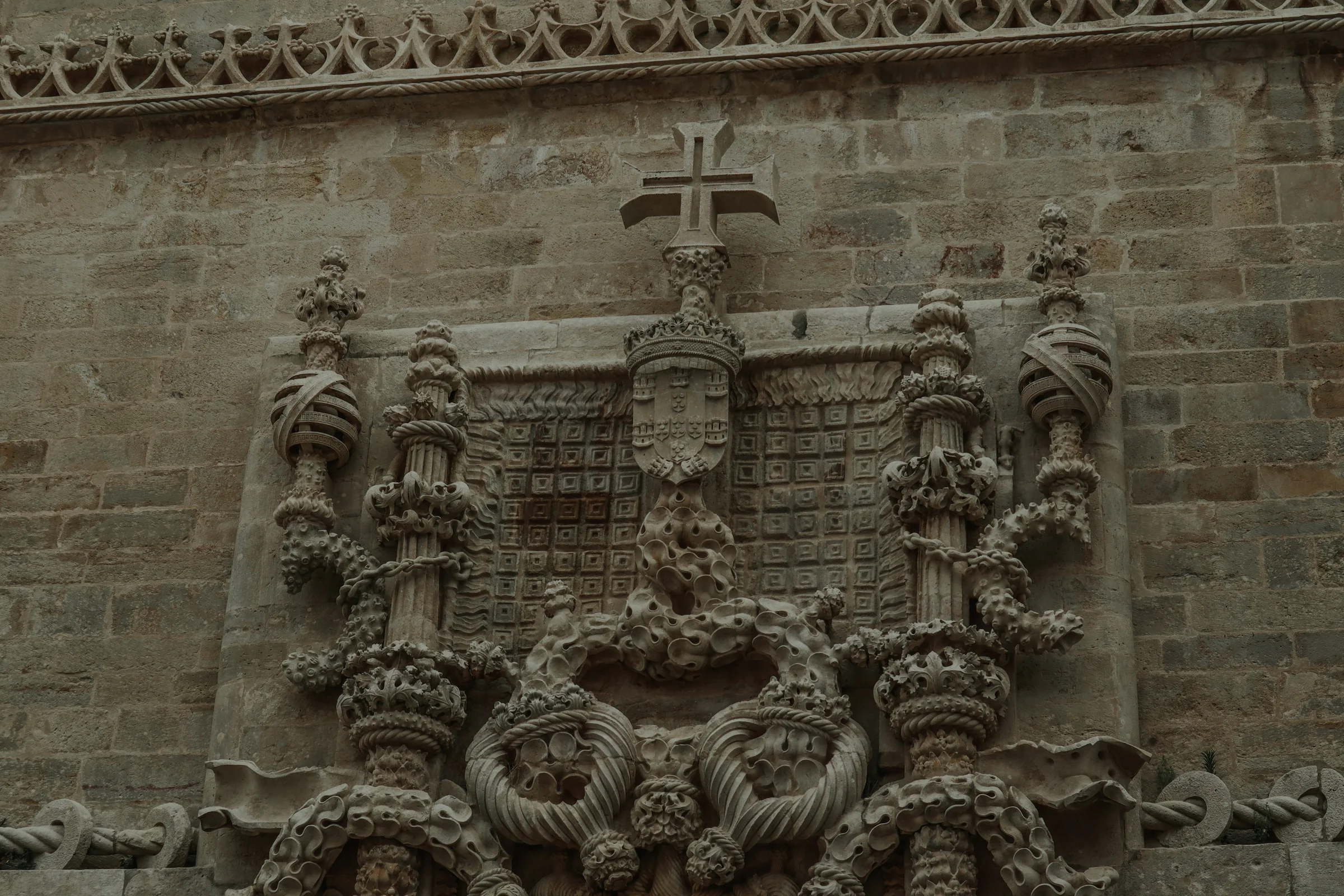
King Manuel I (king 1495-1521) inherited the Grand Mastership of the Order of Christ and undertook a major expansion of the convent. The most spectacular addition was the famous Manueline Chapter House Window (the Janela do Capítulo) on the west facade — an elaborately carved window celebrating Portugal's Age of Discovery, with ropes, anchors, armillary spheres, the Cross of the Order of Christ, and stylised maritime motifs.
Other Manueline additions: the convent's second main church (added against the Charola, with a Manueline portal at the west end), several new cloisters, and elaborate decoration to the existing buildings. The Manueline phase at Tomar runs parallel to the contemporary Manueline phase at Batalha; together they are the two great Manueline cycles in Portugal.
Modern history — dissolution to UNESCO
The Order of Christ was secularised in 1789 — its property nationalised, its religious character ended. The convent buildings continued to be used by the Portuguese state through the 19th century. In 1834 the male religious orders in Portugal were formally dissolved. The convent was declared a National Monument in 1910 and inscribed by UNESCO as a World Heritage Site in 1983.
Restoration work has continued through the 20th and 21st centuries. The Templar Charola interior was extensively restored in the 1980s-1990s. The Janela do Capítulo received conservation work in 2010s. The convent is now open year-round; approximately 250,000 visitors come each year. The site is managed by the national heritage authority.
Frequently asked
Who founded the Convent of Christ?
The Knights Templar in 1160, under their Portuguese Grand Master Gualdim Pais. The original Templar fortress and the Charola (round church) were built between 1160 and 1190 — the Charola is one of the very few medieval round churches in Europe.
What happened to the Templars at Tomar?
Pope Clement V dissolved the Templar Order in 1312 under pressure from King Philip IV of France. In Portugal, King Dinis successfully argued for the creation of a new order — the Order of Christ, founded in 1319 — to inherit the Templar property. The Convent of Christ became the new order's headquarters.
What is Henry the Navigator's connection to Tomar?
Henry the Navigator (Infante Dom Henrique, 1394-1460) was Grand Master of the Order of Christ from 1420 until his death. He used the Order's wealth — much of it inherited from the Templars — to finance Portuguese maritime exploration along the African coast. The Order of Christ symbol decorated Portuguese caravels during the Age of Discovery.
Why is the round church at Tomar called the Charola?
From Portuguese 'charola' meaning a round church or rotunda. The Charola at Tomar was built around 1190 based on the model of the Holy Sepulchre in Jerusalem — a circular plan symbolising the perfection of God. Other medieval round churches in Europe include the Temple Church in London and the Round Church in Cambridge.
When was Tomar's convent made UNESCO?
1983. The inscription covers the entire monastery complex on the Tomar hilltop — the Charola, the Manueline church, the eight cloisters, the Chapter House Window, and the medieval walled garden.
Is the Convent of Christ still a working religious institution?
No. The Order of Christ was secularised in 1789 and the male religious orders dissolved in 1834. The convent buildings are now state property managed by the national heritage authority and operated as a UNESCO heritage site. There is no active religious community.