 Skip-the-line available
 The Charola — One of Europe's Few Templar Round Churches
The 1190 Templar church at Tomar, based on the Holy Sepulchre in Jerusalem. Painted central rotunda, ambulatory, and the Order of Christ's later additions.
The Charola at the Convent of Christ in Tomar is one of the most architecturally distinctive religious spaces in Iberia — a 1190 Templar round church built on the model of the Holy Sepulchre in Jerusalem. Round churches were exceptional in medieval Europe; Tomar's is one of perhaps a dozen surviving complete examples. This guide is a close walkthrough of what to look for in the space.
The architectural plan
The Charola is built as two concentric octagons. The inner octagon is the central rotunda with 16 columns, raised above the surrounding floor and with the high altar at its centre — open in plan to allow the surrounding ambulatory to circle it. The outer octagon is the larger 16-sided wall enclosure. Visitors enter the ambulatory from the convent's later additions and walk around the central rotunda.
The plan derives from the Anastasis (Holy Sepulchre) church in Jerusalem, built by Constantine in the 4th century. Many medieval Templar churches were modelled on it as a deliberate reference to the founding mission of the Order — protection of Christian pilgrims to the Holy Land. The Temple Church in London (1185) and Cambridge's Round Church (c. 1130) are other surviving examples. Most medieval round churches did not survive into the modern period.
The painted decoration
The Charola interior is extensively painted. The central rotunda and the ambulatory walls show frescoes and paintings on wood panels — most dating from the 15th and 16th centuries, with extensive restoration in the late 20th century. The painted programme includes scenes from the life of Christ, the Last Judgement, the lives of saints, and Templar/Order-of-Christ heraldry. The wood ceiling panels are particularly fine.
Lighting is dim by design — the Charola has small windows in the upper rotunda only. The painted programme is best viewed in late morning or early afternoon when sunlight filters in from the upper windows. Visitors typically spend 30-40 minutes in the space; the painted detail rewards slow, close examination. The acoustics are also remarkable — a quiet voice carries across the central rotunda clearly.
The Order of Christ additions
After the Order of Christ inherited the convent in 1319, the Charola was preserved as the original Templar church but flanked by new additions. The most significant is the Manueline nave (Igreja Manuelina), added in the 16th century, which adjoins the Charola on the west side. The Manueline nave has its own entrance and was used for the Order's regular services while the Charola was reserved for ceremonial and feast-day Masses.
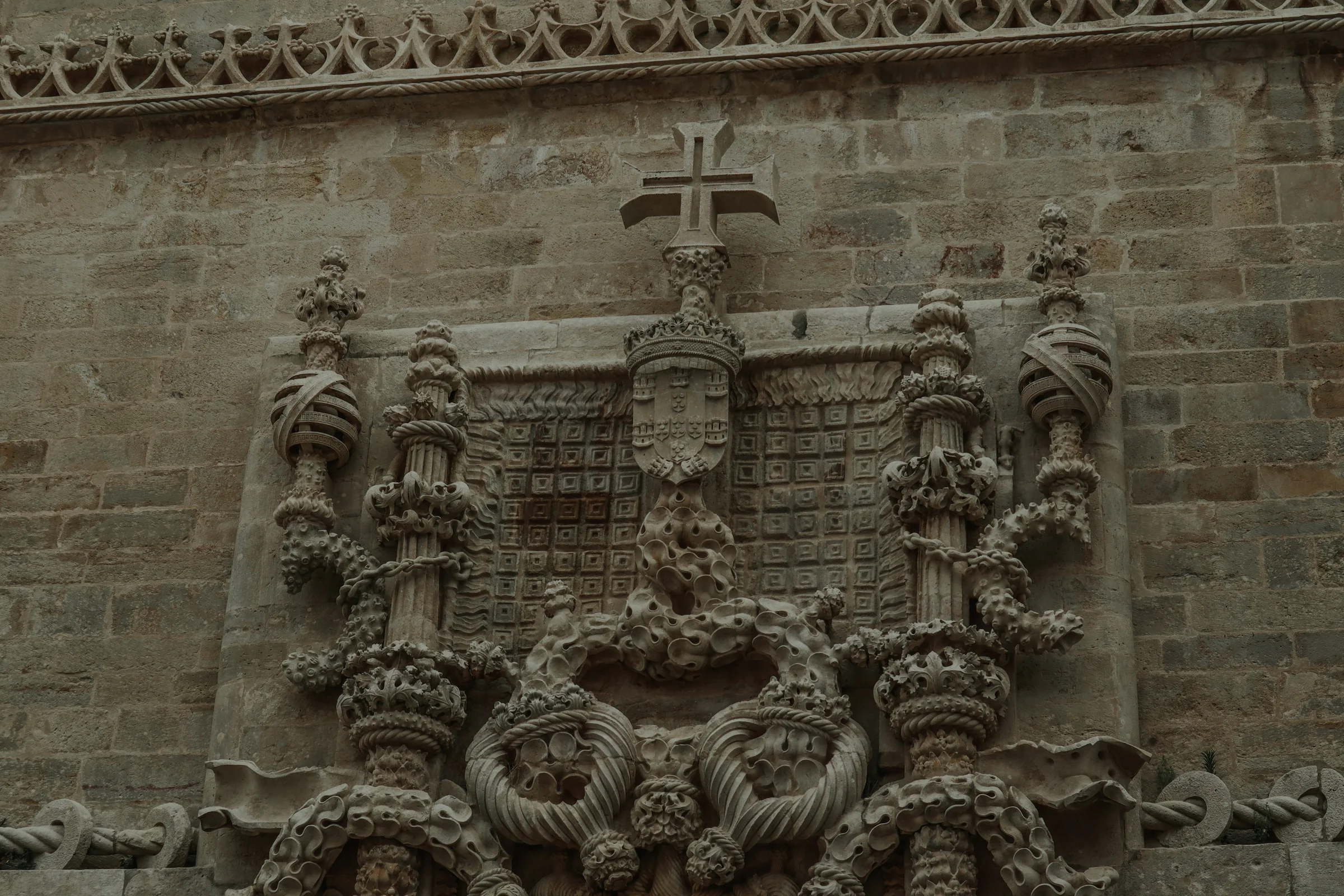
Today visitors approach the Charola through the Manueline nave, with the famous Manueline Chapter House Window (Janela do Capítulo) on the exterior of the convex western wall. The juxtaposition is dramatic — austere 12th-century Templar architecture inside, lavish 16th-century Manueline decoration outside on the same wall. The architectural sequence (round Charola → Manueline nave → Manueline window) is one of the most distinctive in any Portuguese monastery.
How to photograph the Charola
Lighting is dim. Mobile cameras with HDR mode or low-light boost handle the interior well. SLR users need either a high ISO setting or a tripod (which may require a permit). The central rotunda is the photographic focus; stand back in the ambulatory and shoot toward the centre for the symmetrical composition.
Details to capture: the 16 columns of the central rotunda, the painted ceiling panels of the ambulatory, the carved capitals at the base of the rotunda's columns. Flash is not permitted. Most visitors find 15-20 photographs is the right number — the visual repetition of the round plan benefits from a few well-chosen angles rather than coverage of every detail.
Frequently asked
Why is the Templar church at Tomar round?
It was built on the model of the Holy Sepulchre in Jerusalem — a circular church built by Constantine in the 4th century on the site of Christ's tomb. Templar founders chose the round plan as a deliberate reference to the Order's founding mission of protecting Christian pilgrims to the Holy Land. The plan is shared with other surviving Templar churches like the Temple Church in London.
How old is the Charola?
Built around 1190 under the Portuguese Templar Grand Master Gualdim Pais. The basic round plan and the central rotunda's 16 columns date to that period. Painted decoration was added later, primarily in the 15th and 16th centuries, with substantial restoration in the late 20th century.
Why are there 16 columns in the central rotunda?
The 16-column plan is a doubling of the 8-sided geometry — eight is a number associated in medieval Christian symbolism with the eighth day (Resurrection, regeneration). The doubling to 16 (8×2) maintains the symbolic geometry while creating a stronger structural support for the rotunda's upper level.
What is the Order of Christ symbol?
A red cross with a smaller white cross inside it — the symbol the Order of Christ inherited from the Templar Order and used on Portuguese caravel sails during the Age of Discovery. You'll see it carved and painted throughout the Charola and the Convent of Christ.
Can I attend a service in the Charola?
Not regularly — the Charola is no longer used as an active church. Occasional special services may be held (Easter, the 1 June anniversary of the Order's founding) but these are rare. The space is now primarily a heritage attraction with no scheduled services.
Is photography allowed in the Charola?
Yes — personal photography without flash is permitted. Tripods may require a permit. The dim interior rewards mobile cameras with HDR mode; SLRs need high ISO or a tripod. The painted ceiling panels and the central rotunda are the main photographic subjects.